Trust Data and Accreditation Readiness: Using the TrustED® 360 to Strengthen Evidence-Based School Improvement

Updated: Jun 18
Abstract
Accreditation asks schools to demonstrate mission alignment, continuous improvement, stakeholder engagement, and evidence-based practice. This article positions the TrustED® 360 as a practical complement to accreditation readiness because leadership trust data helps schools document capacity, prioritize improvement, prepare for stakeholder interviews, and connect leadership development to institutional growth. The goal is not to make the school appear polished for a visit, but to help the school become more self-aware, more trustworthy, and more consistently aligned with its mission.
Accreditation is often treated as an event: a visit, a report, a set of standards, a committee, and a deadline. At its best, however, accreditation is not an event. It is an evidence-based process of institutional reflection and continual improvement. Schools are asked to show that they know who they are, that their practices align with their mission, that stakeholders have a voice, and that improvement priorities are supported by data. Recent accreditation guidance reinforces that point. Cognia describes its performance standards as a roadmap for school improvement, not merely a checklist for review, and ACSI notes that its Inspire protocol intentionally moves schools away from compliance alone toward a reflective and collaborative improvement process.[1][2]
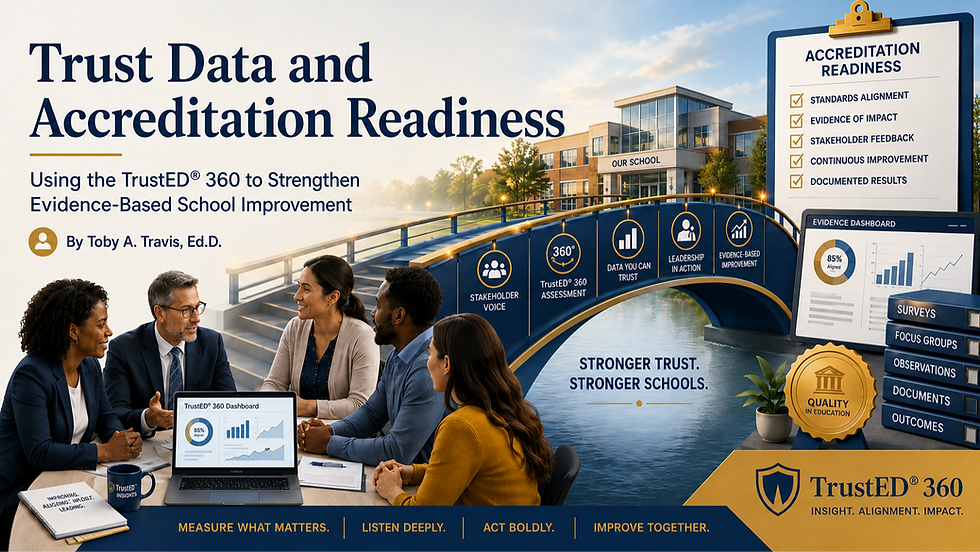
The TrustED® 360 can serve as a valuable tool in that process because it measures a dimension that affects nearly every accreditation standard: the trustworthiness of school leadership. A school may have a compelling mission statement, a strategic plan, curriculum documents, survey data, and financial reports, but if stakeholders do not trust the leadership, institutional improvement will be difficult to sustain. Trust data helps accreditation teams understand whether the leadership bridge is strong enough to carry the school’s stated priorities.
Accreditation should not merely ask whether the school has evidence; it should ask whether the evidence reveals a trustworthy path from mission to practice.
In chapter 9 of my book, TrustED®: The Bridge to School Improvement, I emphasize the need for authentic, honest, and measurable assessment of trust. Repairs to the bridge cannot be initiated without assessing structural integrity and establishing a systematic approach to reassessment. This concept aligns naturally with accreditation readiness. Schools preparing for accreditation must identify strengths, areas for growth, evidence, action plans, and monitoring processes. The TrustED® 360 provides leadership-specific evidence within that broader school improvement cycle.[3]
Freedom Preparatory Academy* entered its accreditation year confident in its documents. Curriculum maps were current. Board minutes were organized. Parent survey results were generally positive. Yet, during preparation meetings, faculty repeatedly described confusion about priorities. Some believed the main goal was academic consistency; others thought the school was emphasizing enrollment growth; still others heard the visit as the administrative priority. The school had artifacts, but it lacked shared meaning. When the leadership team reviewed TrustED® 360 data, the strongest concerns were not about mission language, but about communication, monitoring, and follow-through. The results gave the head of school a clearer way to lead: simplify the priorities, communicate them repeatedly, connect each accreditation artifact to the mission, and invite faculty feedback before the visiting team arrived.
That kind of process strengthens accreditation readiness by connecting evidence to lived experience. Accreditation teams often ask teachers, parents, students, board members, and administrators whether the school’s mission is lived out, whether communication is effective, whether leadership is responsive, and whether improvement processes are credible. TrustED® 360 results help leaders anticipate themes that may surface in those conversations. If the data reveals weak communication, the school can address it before the visit. If the data reveals strong mission alignment, the school can document and celebrate it. Either way, the school is better prepared because it is less dependent on assumptions.
Accreditation also requires mission-driven development. The TrustED® framework connects leadership behaviors to mission, vision, beliefs, values, and current priorities. The Foundation component asks whether leaders operate from shared ideals and maintain focus. The Deck component addresses communication, monitoring, evaluation, intellectual stimulation, and order. The Superstructure addresses culture, relationships, and outreach. Each component has implications for accreditation because each affects whether the school can demonstrate coherence between what it claims and what stakeholders experience.
A strong self-study does not hide weakness; it demonstrates that leaders are trustworthy enough to see weakness clearly and respond faithfully.
Research on school leadership and professional learning supports this evidence-based approach. The Wallace Foundation’s 2021 synthesis of two decades of principal research concluded that effective principals influence student achievement, attendance, and teacher retention, and highlighted leadership behaviors connected to people, instruction, organization, and equity.[4] Learning Forward’s 2022 Standards for Professional Learning emphasize data, implementation, leadership, resources, and outcomes as essential conditions for professional learning that improve leading, teaching, and learning.[5] In other words, improvement is not sustained by aspiration alone. It requires credible data, disciplined support, and evidence of follow-through.
Another accreditation value is triangulation. Strong accreditation self-studies do not rely on a single source of evidence. They compare survey results, performance data, policy documents, observations, interviews, and artifacts. The TrustED® 360 adds a leadership-trust evidence stream. It can be compared with employee surveys, parent feedback, retention data, strategic-plan progress, instructional outcomes, professional development records, and governance reports. If multiple sources point to the same concern, the priority becomes clearer. If data sources conflict, leaders know where to investigate further.
The assessment can also help schools distinguish between program issues and leadership issues. Inconsistent teaching practices may appear to be a curriculum problem. But if the 360 indicates weakness in monitoring, communication, or involvement in curriculum, instruction, and assessment, the root may be leadership practice. Parent dissatisfaction may appear to be a customer-service issue, but trust data may reveal a need for stronger outreach, clarity, visibility, or follow-through. Accreditation readiness improves when leaders can name the true nature of the problem rather than merely reorganizing the evidence binder.
For Christian schools, this connection is especially important. ACSI’s Flourishing School Culture work emphasizes assessing community strengths and weaknesses to develop action plans for transformative results, and ACSI’s accreditation language frames accreditation as a catalyst for improvement in private Christian schools.[2][6] That posture aligns with the TrustED® 360. The question is not, “Can we perform well for a visiting team?” The better question is, “Are we becoming more faithful, coherent, and trustworthy in the way we pursue our mission?”
The value of the TrustED® 360 lies not in displaying a high score, but in demonstrating a mature improvement process.
Using the TrustED® 360 for accreditation readiness should not be about producing a polished image. Accreditation teams are not looking for perfection. They are looking for self-awareness, mission alignment, evidence-based priorities, and follow-through. A school that can say, “Our leadership assessment revealed these strengths and these needs; here is our action plan; here is how we are supporting leaders; here is how we are reassessing,” demonstrates maturity. It also models for the whole community that accreditation is not compliance alone. It is a disciplined opportunity to become more trustworthy in pursuit of the mission.
Applications
For School Leaders: Use TrustED® 360 data as part of the accreditation evidence cycle. Connect results to leadership development, strategic-plan monitoring, stakeholder engagement, and professional learning. Select a limited number of priorities, communicate them clearly, support leaders with coaching or training, and reassess progress.
For Parents: Look for schools that treat accreditation as a meaningful improvement process rather than a marketing badge. Parents should ask how leaders listen to stakeholder feedback, how improvement priorities are selected, and how the school measures progress over time.
For Christian School and Church Leaders: Remember that accreditation readiness is also a stewardship issue. Churches and boards that sponsor or oversee schools should encourage transparent evidence, mission alignment, and leadership development. Trustworthy leadership strengthens both institutional credibility and gospel-shaped witness.
The TrustED® 360 is valuable because it helps schools connect leadership development to institutional improvement. Accreditation asks, in effect, whether the school has a trustworthy bridge from mission to practice. Trust data helps answer that question. More importantly, it helps leaders strengthen the bridge before others are asked to cross it.
Endnotes
*Name changed to protect privacy and confidentiality.
[1] Cognia, “Performance Standards: Standards-Based Approach,” accessed May 31, 2026, https://www.cognia.org/standards-based-approach/.
[2] Association of Christian Schools International (ACSI), “Accreditation Documents,” accessed May 31, 2026, https://www.acsi.org/accreditation-certification/accreditation-for-schools/resources/accreditation-documents; ACSI, “School Accreditation,” accessed May 31, 2026, https://www.acsi.org/school-accreditation.
[3] Toby A. Travis, TrustED: The Bridge to School Improvement (2021), chapter 9, especially “The Value of a School Leader 360 Assessment” and “Putting Data to Work.”
[4] Jason A. Grissom, Anna J. Egalite, and Constance A. Lindsay, How Principals Affect Students and Schools: A Systematic Synthesis of Two Decades of Research (The Wallace Foundation, 2021), https://wallacefoundation.org/report/how-principals-affect-students-and-schools-systematic-synthesis-two-decades-research.
[5] Learning Forward, Standards for Professional Learning (2022), https://standards.learningforward.org/standards-for-professional-learning/; Learning Forward, Standards for Professional Learning: The Research (2022), ERIC ED623501.
[6] ACSI, “Flourishing School Culture,” accessed May 31, 2026, https://www.acsi.org/flourishing-schools-culture; ACSI, “Flourishing Resources,” accessed May 31, 2026, https://www.acsi.org/flourishing-schools-culture/resources.
[7] Anthony S. Bryk and Barbara Schneider, Trust in Schools: A Core Resource for Improvement (Russell Sage Foundation, 2002); Megan Tschannen-Moran, Trust Matters: Leadership for Successful Schools, 2nd ed. (Jossey-Bass, 2014).
[8] James W. Smither, Manuel London, and Richard R. Reilly, “Does Performance Improve Following Multisource Feedback? A Theoretical Model, Meta-Analysis, and Review of Empirical Findings,” Personnel Psychology 58, no. 1 (2005): 33–66.
About the Author
Dr. Toby A. Travis is the author of TrustED®: The Bridge to School Improvement and the developer of the TrustED® School Leader 360 Assessment. He has served as a teacher, principal, academic director, head of school, superintendent, consultant, and graduate faculty member, helping schools and school leaders build cultures of trust that support mission fulfillment, stakeholder confidence, and continual school improvement.
©2026 Toby A. Travis. All rights reserved.


Comments