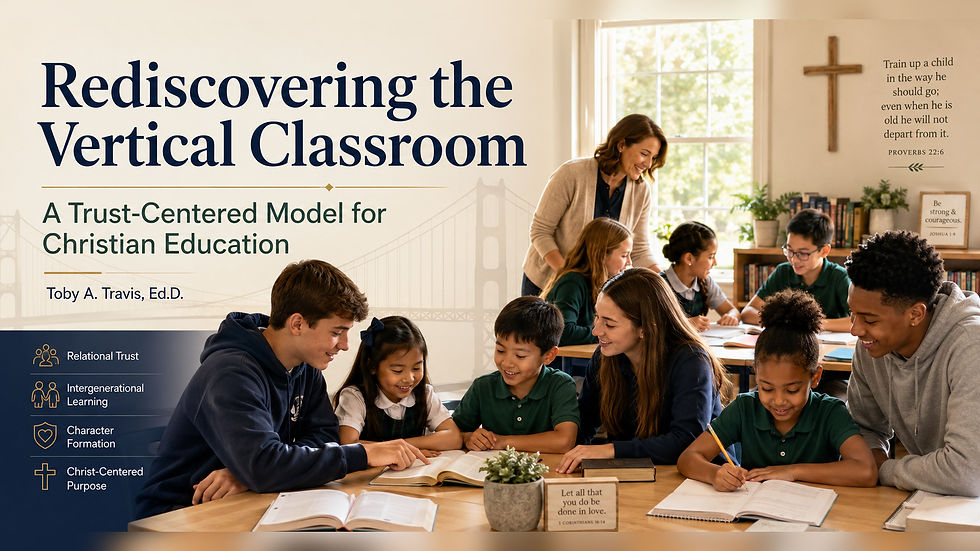
Rediscovering the Vertical Classroom: A Trust-Centered Model for Christian Education

Updated: Jun 18
Abstract
Vertical classrooms, sometimes called multi-age, multi-grade, or cross-grade classrooms, are not a nostalgic return to the one-room schoolhouse so much as a renewed commitment to relationships, discipleship, and instructional design. For Christian schools, the question is not whether students should be grouped differently simply for efficiency, but whether school structures help students become known, supported, challenged, and formed within a trusted learning community. Current research on relational trust, inclusive education, and multi-age learning suggests that heterogeneous classrooms can strengthen academic and social outcomes when they are intentionally designed, carefully led, and supported by a clear philosophy of education. The vertical classroom offers Christian schools a practical model for aligning biblical community, differentiated instruction, peer mentoring, and the six components of the TrustED® framework.
The vertical classroom is not a step backward; it is a timely recovery of something Christian education should never have surrendered: formation through trusted community. For generations, many children learned in small, multi-age settings where older students modeled responsibility, younger students observed and aspired, and the teacher knew the learners well enough to teach both content and character. As schools consolidated and grade-level structures became standard, education gained efficiencies, but it often lost some of the relational continuity that helps students flourish.
Research continues to remind us that trust is not an ornamental value in schools; it is a core resource for improvement. Bryk and Schneider’s study of 400 Chicago elementary schools found that relational trust among teachers, students, parents, and principals plays a central role in effective school communities.1 In a Christian school, this finding should sound familiar. Scripture has long taught that people grow through faithful relationships: encouragement, accountability, mentoring, and shared responsibility. A vertical classroom gives those relationships time and space to mature.
“A vertical classroom is not merely a scheduling choice. It is a leadership decision about the kind of community a school is trying to become.”
Covenant Ridge Christian School* had strong teachers, faithful families, and a clear mission, but its smallest elementary grades were beginning to feel fragile. Some classes were tiny, others were full, and teachers felt pressure to cover every grade-level objective in isolation. After a year of prayer, study, and conversations with parents, the school piloted vertical classrooms for grades 1-2 and 3-4. The goal was not to save money, though stewardship mattered. The goal was to create a more stable learning community where students could be known over time, and peer mentoring became the norm rather than occasional.
The first months required careful communication. Parents needed assurance that rigor would not be diluted. Teachers needed planning time and professional support. Students needed routines for independent work, small-group instruction, and peer collaboration. By midyear, however, the culture had shifted. Younger students were learning classroom habits from older students. Older students were taking on more responsibility because someone was watching and learning from them. The teacher was no longer simply delivering lessons to a single age group; she was orchestrating a community of learners.
This pattern is supported by the broader literature on multi-age education, though the research should be read carefully. A systematic review of multiage education notes that the field uses varied terms and that implementation quality matters greatly.2 A recent study of multigrade classrooms likewise cautions that mixed-age grouping by itself does not guarantee academic benefit; pedagogy, classroom management, and instructional design remain decisive.3 In other words, vertical classrooms are not magic. They are powerful only when they are intentional.
That intentionality is where trusted leadership matters. The TrustED® framework provides school leaders with a helpful lens for building vertical classrooms effectively. The Foundation of beliefs and values asks whether the model grows out of the school’s mission rather than convenience. The Substructure of connection and support asks whether students, teachers, and parents are adequately cared for through the transition. The Bearings of flexibility and involvement remind leaders that vertical classrooms require adaptable instruction and meaningful stakeholder participation. The Girders of adaptation and contextualization help teachers align standards to real students rather than generic pacing charts. The Superstructure of culture and relationships points to the peer mentoring and discipleship that can define the room. The Deck of clarity and order reminds everyone that flexibility works only when expectations, routines, and responsibilities are clear.
“Mixed ages do not create community automatically; trusted leadership, clear routines, and shared purpose do.”
Inclusive education research adds another important layer. Hehir and colleagues summarized evidence from more than 280 studies in 25 countries and concluded that inclusive educational settings can provide substantial short- and long-term benefits for students with and without disabilities.4 While inclusion and vertical classrooms are not identical, they share a central conviction: students benefit when difference is not treated as a problem to hide but as a community reality to steward. In a Christian school, this is more than an instructional strategy. It is a theological commitment to the dignity of every student as an image-bearer of God.
The biblical vision of formation is naturally intergenerational. Deuteronomy 6 describes teaching that happens as families sit, walk, lie down, and rise. Titus 2 presents older believers instructing younger believers. Paul’s picture of the body in 1 Corinthians 12 assumes that different members need one another. A vertical classroom places this biblical logic into the daily rhythms of school life. Older students can serve without superiority. Younger students can learn without embarrassment. Teachers can cultivate a room where academic growth, social maturity, and spiritual formation reinforce one another.
The model also carries practical implications for school leaders. Leaders should begin with mission clarity, not staffing pressure. They should prepare parents with transparent explanations of how standards, assessment, grouping, and reporting will work. They should provide teachers with training in differentiation, formative assessment, small-group instruction, and classroom routines. Should they also evaluate the pilot with both academic data and relational evidence: Are students progressing? Are parents informed? Are teachers supported? Are older students growing in responsibility? Are younger students gaining confidence?
Faculty and staff need to see the vertical classroom as a shared professional practice, not an isolated experiment. Teachers must collaborate across grades, identify essential learning outcomes, design flexible groups, and communicate consistently. Support staff can reinforce routines and help students practice independence. Administrators can protect planning time and prevent the model from becoming merely “two grades in one room.”
Parents need an invitation into the philosophy. Many parents' concerns are reasonable: Will my child be challenged? Will my child be held back? Will the teacher have enough time? Schools build trust by answering these questions before anxiety fills the silence. When parents understand that vertical classrooms can offer leadership opportunities, individualized instruction, and deeper relationships, they are more likely to become partners rather than skeptics.
For Christian schools, the opportunity is especially compelling. A vertical classroom can become a living picture of discipleship, service, and belonging. It can help smaller schools remain mission-faithful without imitating factory-model assumptions. It can help larger schools recover the feel of a more intimate learning community. Most importantly, it can remind us that Christian education is not simply the delivery of Christian content. It is the formation of students in a community ordered by truth, grace, responsibility, and love.
“Christian education is not merely Christian content delivered in school hours; it is formation within a trusted learning community.”
The vertical classroom is not the right model for every grade, every teacher, or every season. But neither should it be dismissed as outdated. When grounded in mission, supported by research, guided by trusted leadership, and shaped by biblical community, it can become one of the most practical ways Christian schools recover relational depth in an age of fragmentation. The question is not whether the old one-room schoolhouse should return. The better question is whether our current structures help students know and be known, serve and be served, lead and be led, and grow together in wisdom and stature before God and others.
Endnotes
*Name changed to protect privacy and confidentiality.
1. Anthony S. Bryk and Barbara Schneider, “Trust in Schools: A Core Resource for School Reform,” Educational Leadership 60, no. 6 (2003): 40-44; see also University of Chicago Consortium on School Research, Trust in Schools: A Core Resource for School Reform.
2. Michelle Ronksley-Pavia, Donna Pendergast, and Georgina Barton, “Multiage Education: An Exploration of Advantages and Disadvantages through a Systematic Review of the Literature,” Australian Journal of Teacher Education 44, no. 5 (2019).
3. See recent empirical work on multigrading and student achievement, including “Good or Bad? Understanding the Effects over Time of Multigrading on Student Achievement,” Economics of Education Review (2023).
4. Thomas Hehir et al., A Summary of the Evidence on Inclusive Education, Abt Associates, 2016. The report summarizes evidence from more than 280 studies across 25 countries.
5. Toby A. Travis, TrustED®: The Bridge to School Improvement (2021).
6. Scripture references include Ecclesiastes 4:9-10; Deuteronomy 6:7; Titus 2:1-8; 1 Corinthians 12; and Luke 2:52.
About the Author
Dr. Toby A. Travis is the founder and developer of the TrustED® framework for school improvement and an executive consultant with the Global School Consulting Group. He serves schools worldwide in leadership development, accreditation, organizational improvement, and the cultivation of trust-centered learning communities.
©2026 Toby A. Travis. All rights reserved.


Comments