Brand Loyalty, Relational Trust, and the Future of Schools
- Dr. Toby A. Travis

- May 19
- 8 min read
Updated: Jun 18
Implications for Schools, Ministries, Churches, and Mission-Driven Organizations
Abstract
This article examines the essential connection between trust, loyalty, and long-term organizational health, especially within schools, ministries, churches, and mission-driven organizations. Building from current research on declining institutional trust, parent expectations, employee engagement, and faith-community credibility, the article argues that trust is not a soft or secondary leadership concern, but a strategic necessity that directly influences enrollment, retention, giving, participation, reputation, morale, and mission effectiveness. For schools, trust shapes whether parents will entrust leaders with the intellectual, emotional, physical, and spiritual formation of their children; for churches and ministries, trust determines whether people will remain engaged, give generously, invite others, and follow leadership through change. Ultimately, the article calls leaders to move beyond branding as image management and instead cultivate trust through consistency, transparency, competence, compassion, alignment with mission, and faithful stewardship.
In the corporate world, the trust-to-loyalty connection is now well documented. PwC's Trust in U.S. Business Survey reports that 61 percent of consumers have recommended a company they trust to family or friends, 46 percent have purchased more from a trusted company, and 28 percent have paid a premium. Conversely, four in ten customers report they no longer purchase from a company due to a lack of trust. The 2024 Edelman brand research similarly found that when consumers fully trust a brand, they are more likely to purchase it, advocate for it, and remain loyal even when the brand makes a mistake or faces an accusation. The 2025 Edelman brand report notes that consumers are increasingly seeking optimism, support, emotional connection, and personal relevance from the brands they choose. 2,3,4
Those findings are not only about retail. They are about human behavior. People commit where they trust. They disengage where they do not. They stay where they believe leaders are competent, consistent, honest, caring, and aligned with the mission. They leave when those expectations are violated.
Trust is not a soft virtue. It is an operational infrastructure.
This is especially true for schools. Parents are not simply purchasing a service. They are entrusting their children - their most precious earthly responsibility - to the care, formation, protection, instruction, and influence of others. The decision to enroll or re-enroll is not merely a financial decision; it is a deeply relational act of trust. Families are asking, often implicitly: Will my child be known? Will my child be safe? Will my child be challenged? Will my child be loved? Will this school form the kind of person we hope our child becomes?
That is why the phrase "school pride" may not be strong enough. In many cases, what we call school pride is actually the fruit of school trust. When trust is present, families advocate. Alumni return. Teachers invest. Students identify with the mission. Donors give. Churches partner. Community members defend the institution. But when trust is broken, loyalty can dissipate quickly, even in organizations with long histories, strong programs, beautiful facilities, or compelling mission statements.
The Current Trust Climate
Recent research makes clear that organizations are operating in a low-trust environment. Edelman's 2026 Trust Barometer describes a global climate marked by polarization, skepticism, and institutional strain. Its findings continue a long-running trend: people are evaluating institutions not only by what they promise, but by whether they are perceived as competent, ethical, responsive, and worthy of confidence. Edelman's 2026 release also notes that business is now perceived as more ethical and competent than other major institutions, a finding that should give mission-driven organizations pause. If churches, ministries, schools, and nonprofits assume they are automatically trusted because of their stated purpose, they may be assuming too much. 1
Gallup-related findings point in the same direction for churches and religious leaders. Lifeway Research, reporting on Gallup data, noted that confidence in the church or organized religion rose to 36 percent in 2025 after several years near record lows. That modest improvement is encouraging, but the larger picture remains sobering. Lifeway also reported that only 27 percent of U.S. adults rated clergy members' honesty and ethical standards as high or very high in Gallup's latest Honesty and Ethics Survey, a record low. For ministries and churches, this means trust can no longer be presumed simply because the organization is faith-based. It must be earned, stewarded, repaired when necessary, and demonstrated through daily patterns of integrity. 5,6
Schools are not immune to this larger cultural dynamic. Public confidence in educational institutions has become increasingly fragmented and, in some contexts, politically polarized. Pew Research Center's 2024 work on Americans' views of K-12 public schools and colleges documented sharp partisan differences in perceptions of educational institutions. For private, independent, Christian, and international schools, this broader environment creates both challenge and opportunity. Families are more attentive to alignment, transparency, safety, worldview, communication, and institutional consistency than ever before. 7
Why Schools Should Pay Attention
Current school-choice and parent-satisfaction data show that families often express high satisfaction with private schools. EdChoice's 2024 survey reported that 97 percent of private school parents said they were satisfied with their child's school, with 60 percent saying they were very satisfied. That is a powerful indicator of loyalty and perceived value. Yet satisfaction should not be mistaken for guaranteed trust. Satisfaction can describe a present experience; trust predicts whether families will stay, sacrifice, recommend, and extend grace when difficulties arise. 8
Research on school improvement has long shown that relational trust is a core resource for change. Anthony Bryk and Barbara Schneider's landmark work, Trust in Schools, demonstrated that the quality of relationships among principals, teachers, parents, and communities is not peripheral to school improvement; it is foundational. More recent education-sector commentary and research continue to affirm that relational trust matters across the entire education ecosystem - among students, educators, families, school leaders, and community partners. Reviews of teacher-retention research have also identified leadership, culture, working conditions, and relational trust as important contributors to whether teachers remain in schools. 9,10,11
This matters because schools cannot fulfill their mission through marketing alone. Branding may create awareness, but trust creates belonging. A beautiful website may tell a story, but lived experience confirms whether that story is true. Enrollment campaigns may bring families to the door, but trust determines whether they stay long enough to become ambassadors.
Branding may create awareness, but trust creates belonging.
For Christian schools, the implications are even deeper. Education is not primarily the production of graduates, test scores, and diplomas, although those may be important outcomes. Christian education is a work of discipleship, formation, and community. It is relational before it is transactional. If the school claims to partner with parents, shepherd students, and cultivate wisdom, then every interaction either strengthens or weakens the credibility of that claim.
Implications for Ministries, Churches, and Organizations
The same trust dynamics apply beyond schools. Ministries, churches, nonprofits, and mission-driven organizations often use language of calling, service, community, and transformation. But in a skeptical culture, language alone does not build trust. Stakeholders increasingly look for evidence: financial transparency, leader integrity, consistent communication, protection of the vulnerable, responsiveness to concerns, and alignment between stated values and actual behavior.
For churches and ministries, trust is deeply tied to spiritual credibility. Members and participants are not merely attending programs. They are opening their lives, families, finances, questions, wounds, and hopes to a community of spiritual influence. When leaders handle that responsibility with humility and integrity, trust grows. When leaders minimize concerns, communicate selectively, protect image over people, or act inconsistently with the mission, trust erodes quickly.
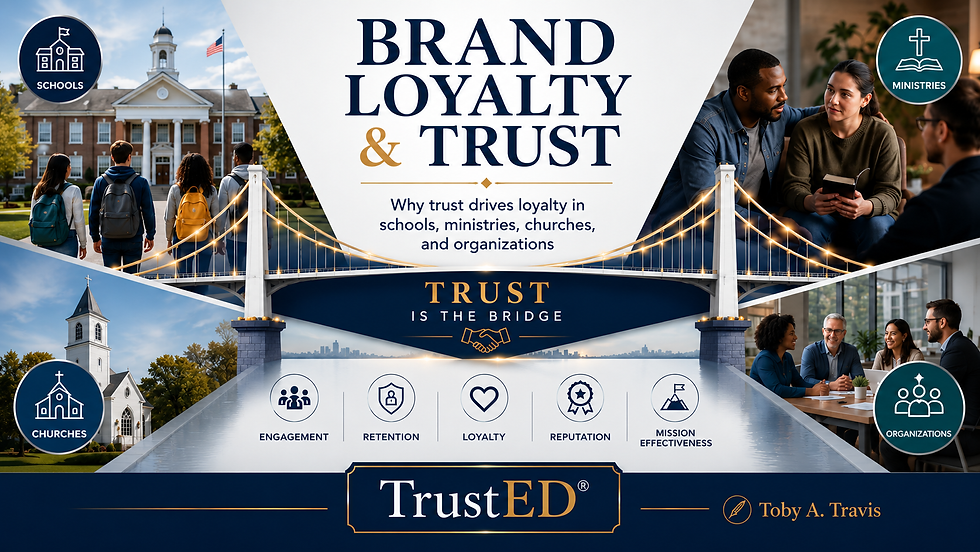
For nonprofits and mission-driven organizations, trust is also tied to stewardship. Donors want to know that gifts are used wisely. Volunteers want to know that their time matters. Staff want to know that leaders practice what they promote. Partners want to know that collaboration will be handled with competence and care. In each case, trust becomes the bridge between stated mission and sustained participation.
Five Strategic Trust Investments
Leaders who want to build durable loyalty should stop treating trust as an assumed outcome and begin treating it as a strategic responsibility. The following investments apply to schools, ministries, churches, and organizations alike.
1. Measure trust intentionally. Organizations measure enrollment, attendance, giving, academic results, web traffic, and program participation. They should also measure trust. Surveys, listening sessions, exit interviews, parent forums, staff climate data, donor feedback, and ministry-partner conversations can reveal whether stakeholders experience the organization as credible, caring, consistent, and mission-aligned.
2. Communicate with clarity and humility. Trust grows when people are not left guessing. Leaders should communicate early, plainly, and regularly, especially during change, conflict, crisis, or uncertainty. Humility matters as much as frequency. Stakeholders trust leaders who can explain decisions, acknowledge limits, admit mistakes, and invite appropriate feedback.
3. Align promises with lived experience. Every organization has a brand promise, whether formally stated or informally perceived. Schools promise formation and excellence. Churches promise shepherding and spiritual care. Ministries promise mission impact. Nonprofits promise stewardship. Trust grows when daily practices match those promises.
4. Invest in relational leadership. Programs do not build trust by themselves; people do. Leaders should equip faculty, staff, pastors, volunteers, board members, and managers to practice high-trust behaviors: listening carefully, following through, resolving conflict directly, protecting confidentiality, and demonstrating care without lowering standards.
5. Repair trust quickly when it is damaged. No institution is perfect. What separates high-trust organizations from low-trust organizations is not the absence of mistakes, but the way mistakes are handled. Transparent acknowledgment, appropriate apology, corrective action, and consistent follow-through are essential to rebuilding credibility.
A Closing Challenge
The original question remains the right one: To what extent is your school intentionally investing resources, time, and professional development into expanding trust? But the question should now be widened: To what extent is your ministry, church, nonprofit, or organization intentionally building trust with the people God has called you to serve?
Trust is not merely a communication strategy. It is a leadership discipline. It is not merely a brand asset. It is a moral responsibility. For schools, it affects enrollment, retention, teacher engagement, parent partnership, student belonging, donor confidence, and mission sustainability. For churches and ministries, it affects spiritual credibility, volunteer commitment, giving, participation, and witness. For organizations, it affects loyalty, advocacy, resilience, and long-term impact.
In a low-trust age, the organizations that will endure are not necessarily those with the loudest messaging or most impressive platforms. They will be the organizations whose leaders have earned the right to be believed.
In a low-trust age, leaders must earn the right to be believed.
Questions for Leadership Reflection
Where are we assuming trust rather than measuring it?
What promises do our families, members, donors, volunteers, or employees believe we have made?
Where does our lived experience most clearly match our stated mission?
Where might there be a gap between our messaging and stakeholder experience?
How quickly and transparently do we respond when trust is strained?
What professional development or board-level conversation is needed to make trust a strategic priority?
Endnotes
1. Edelman Trust Institute, 2026 Edelman Trust Barometer Global Report, 2026, https://www.edelman.com/trust/2026/trust-barometer.
2. Edelman Trust Institute, 2025 Edelman Trust Barometer: Special Report - Brand Trust, From We to Me, 2025, https://www.edelman.com/trust/2025/trust-barometer/special-report-brands.
3. PwC, Trust in U.S. Business Survey, https://www.pwc.com/us/en/library/trust-in-business-survey.html.
4. Edelman Trust Institute, 2024 Edelman Trust Barometer: Special Report - Brands and Politics, 2024, https://www.edelman.com/trust/2024/trust-barometer/special-report-brand.
5. Lifeway Research, Americans' Trust in the Church Rebounds Slightly, July 25, 2025, https://research.lifeway.com/2025/07/25/americans-trust-in-the-church-rebounds-slightly/.
6. Lifeway Research, Americans' Trust in Pastors Hits Historic Low, January 16, 2026, https://research.lifeway.com/2026/01/16/americans-trust-in-pastors-hits-historic-low/.
7. Pew Research Center, Colleges and Universities, K-12 Public Schools, February 1, 2024, https://www.pewresearch.org/politics/2024/02/01/colleges-and-universities-k-12-public-schools/.
8. EdChoice, Choosing Private School in 2024, 2024, https://www.edchoice.org/choosing-private-school-in-2024/.
9. Anthony S. Bryk and Barbara Schneider, Trust in Schools: A Core Resource for Improvement, Russell Sage Foundation, 2002; University of Chicago Consortium on School Research summary, https://consortium.uchicago.edu/publications/trust-schools-core-resource-improvement.
10. Brookings Institution, Strengthening Trust in Schools and Communities, 2025, https://www.brookings.edu/articles/strengthening-trust-in-schools-and-communities/.
11. Education Endowment Foundation / Generate Teaching Hub summary of teacher retention research, https://generateteachinghub.org/leadership-and-development/key-reports-and-policies/eef-teacher-retention-reports/.
About the Author
Dr. Toby A. Travis is an educator, consultant, speaker, and author of the award-winning book, TrustED®: The Bridge to School Improvement. His work focuses on the central role of trusted leadership in school improvement, organizational health, and mission-centered leadership. He has served schools and organizations across the United States and internationally, helping leaders build cultures of trust, clarity, and sustainable improvement.
© 2026 Toby A. Travis. All rights reserved.


Comments